Wednesday, 12 May 2010

American Layer Cake- not Swiss enough!


Acting on a tip-off from David Lebovitz, who said it was one of the best cookbooks this year (or last year), I purchased (from abebooks, I'm cheap), Baked: New Adventures in Baking.

A few days later, reminded that Peter's Annual Family Reunion was coming up, and having been volunteered to make a first course (not a difficult task- my faithful tabbouleh came to the rescue) and a dessert, I opened it up at the cakes section (real cakes, not French cakes!), and came up with The Whiteout Cake.

Which looked pretty nice. A long recipe, longer than what I'd usually make, but a challenge is always good. And I need to break out of my usual habits and recipes I've repeated so many times...

The problem was... I didn't start until just before 9 p.m.

Nor did I realise that I was going to end up using my blender (and wishing I had a second blender), four mixing bowls, two measuring cups, two measuring spoons, numerous other spoons and forks, several knives, both spatulas, and a heap of other tools.

Yeah. Well. A professional kitchen would have been nice too.

Ingredients (copyright Baked, as above; slightly tweaked by me as indicated):
- 2.5 cups farine fleur (cake flour)
- 3/4 cup flour
- 1 tbs baking powder
- 1 tsp baking soda
- 3/4 teaspoon salt
- 115 g butter (my apologies, but although I have an American measuring cup, and am quite happy to measure things like flour and sugar in it, I'm not trying to cram butter into it! Hence, I convert, with a handy online tool)
- 1/2 cup vegetable fat for cooking (vegetable shortening- I had to figure this one out by cramming it into the cup, and very annoying it was too)
- 1 3/4 cups sugar
- 3 vanilla pods, seeded (my change- I couldn't find pure vanilla extract, so couldn't put it one tbs thereof)
- 1 large egg
- 1 1/2 cups ice cold water
- 3 large egg whites, at room temperature (I then made mayonnaise with the yolks)
(- 1/4 tsp cream of tartar- in brackets because I didn't have any and have no idea what it is in French nor where to get it, so I didn't bother)


Preheat the oven to 325F/170C. Butter three (two, in my case) 8-inch (20 cm) round cake pans, flour them, tip out excess flour.

Sift the flours, baking powder, baking soda, and salt together. Set aside.

In the bowl of the blender, fitted with the paddle attachment (first time I've used that, and I've had the blender about 5 years!), beat the butter and vegetable fat together until creamy. Add the sugar and vanilla and beat until fluffy. Scrape down the bowl repeatedly. Add the egg whites, beat until "just" combined, whatever that means. Add the flour mixture, alternating with the ice water, in three separate additions, beginning and ending with the flour mixture (read that twice- it means you add the water twice, and the flour three times). Scrape down the bowl, mix again.

In another bowl (!), whisk the egg whites (and cream of tartar) until soft peaks form. Just soft ones. Not firm ones. Not hard ones. Soft. OK?

Gently fold the egg whites into the batter. Which, in my case, meant using a fourth bowl, as the mixing bowl of my blender wasn't big enough for the egg whites to go in too, besides having the great big paddle thingy at the bottom.

Divide the batter into the pans, and smooth the top. I did this by weighing my bowl at the beginning, then weighing my batter, dividing it into three in my small but perfectly formed head (OK, I did it on the calculator), and spooning it into the tins one by one, as they sat on the weighing machine. And only doing two tins, as I'd only bought two, thinking that I'd just do the third one afterwards.

Bake the cakes for 40-45 mns (I did 45), rotating the pans half-way through, until a toothpick inserted comes out clean. Transfer the cakes to a wire rack and let cool for 20 minutes. Remove the molds, slide onto rack, allow to cool completely.

Aren't my cakes pretty? And the tops, when I cut them off, tasted really good too. But I'm getting ahead of myself...

White Chocolate Frosting:
- 175g white chocolate, broken up
- 1 1/2 cups sugar
- 1/3 cup flour
- 1 1/2 cups milk
- 1/3 cup creme fraiche
- 340g (three. hundred. and. forty!!!) butter, soft but cool (erm, yeah, right, I just left it out for half an hour), cut into small pieces (torn into them, more like!)
(- 1 tsp pure vanilla extract- I didn't bother at all, thinking the cake had plenty of vanilla in it)

Melt the chocolate however you think best (I use the microwave), stir, and set aside to cool.

In a saucepan, whisk the sugar and flour together. Add the milk and cream and cook over medium heat, whisking quite attentively or you'll burn the bottom the way I almost did (OK, did in one little edge, as I paid attention to the book's instructions to "whisk occasionally"), until the mixture has come to a boil and thickened, which takes as long as it takes, no matter the book saying "about 20 minutes", because it was nowhere near that.

Now comes the really annoying part. As you'll have read ahead, you will have washed up your blender, since you only have one. Because you now pour the mixture into the blender, fitted-with-the-paddle-attachment, and, wait for it, you're supposed to "beat on high speed until cool".

Erm, yeah, right. How long is that supposed to take?

And, in my case, there was no way that it was going to cool like that. I kept on having to take the lid off to let steam out. I found the best way was to leave it with the lid off for a few minutes, then whisk the cool layer into the hotter layer, and repeat. It took... oh, quite a while. A good 40 minutes. In the meantime, I baked my other cake, and let that cool.

You then add the butter, mix until thoroughly amalgamated. Increase the speed and beat until the frosting is light and fluffy, whatever that is supposed to mean. I made a stab at what I thought it meant- spreadable, without being concrete.

Add the (vanilla and) white chocolate, and continue mixing until combined. The book then says that if the frosting is too soft, put the bowl in the refrigerator to chill slightly, then beat again until it is the proper consistency. Which is what I did. It also tells you that if it's too firm, set the bowl over a pot of simmering water and beat with a wooden spoon until it is the proper consistency. Me, I'd just turn the blender on again...


Assembling the cake: Refrigerate the frosting for only a few minutes, until it can hold its shape. Place one cake on a serving platter, and trim the top to create a flat surface. Um. Yeah. Sort of. Evenly spread about 1 1/4 cups of the frosting on top. Add the next layer, having trimmed it first (the book says to do it second, no, bad idea), frost it, add the third layer.

The book then says to "crumb coat" the cake, i.e. to put a thin layer of frosting on it to catch the crumbs, then put the cake in the refrigerator for about 15 mns to firm up the frosting. I did, but my layer had no crumbs in it anyway, so I wasn't too bothered. Frost the top and the sides with the remaining frosting.


Now, I'd also bought white sprinkles, as the book called this "whiteout", and said to decorate with white sprinkles or nonpareils. Well, my cake wasn't white. If I'd have been being nice, I'd have said "cream-coloured", but it wasn't, it was butter-coloured. White sprinkles would have looked awful. So I didn't have anything to decorate it with. It would have looked OK with multi-coloured ones, but I didn't have any. So I left it as it was. And went to bed. Because it was gone 1 a.m.!

The verdict:
I'd use the cake base again. Definitely. It was delicate, it was moist, it tasted delicious.

The frosting I'd make again, if I had the sort of sweet tooth that would render me toothless by the age of 40, instead of being 35 and not having a single cavity. It was... rich, it was gooey, it was sweet, it was like eating butter and sugar together, and although some older members of the extremely extended family liked it, once they got over the way it looked (I heard two different people ask others "What on earth is that?!?" when the cloche was taken off), it was just far too sweet for most of them.

Besides the way it looked. It was... alien. Too alien for a good, Swiss family. Too much of everything, in fact.

But I will probably use the cake recipe, in two layers, sandwiched with some home-made strawberry jam, and a dusting of icing sugar over the top. Because that would give a much nicer fate to the cake- instead of what happened to this one.

Just under half of it got tipped into the garbage earlier this evening.

Saturday, 8 May 2010

Feeding the Beast


If the kid is going to turn the food down... then it may as well look good.

And if you're going to eat your kid's dinner after they've gone to bed, you had better like lovely, buttery, young Gouda.

Saturday, 1 May 2010

Pumpkin Gratin- when spring isn't living up to expectations!


As I've mentioned in recent entries- spring came, passed, summer came, passed, and we went back to it being late winter. It's been cold, it's been raining, it's been generally the sort of weather where you wish it weren't.


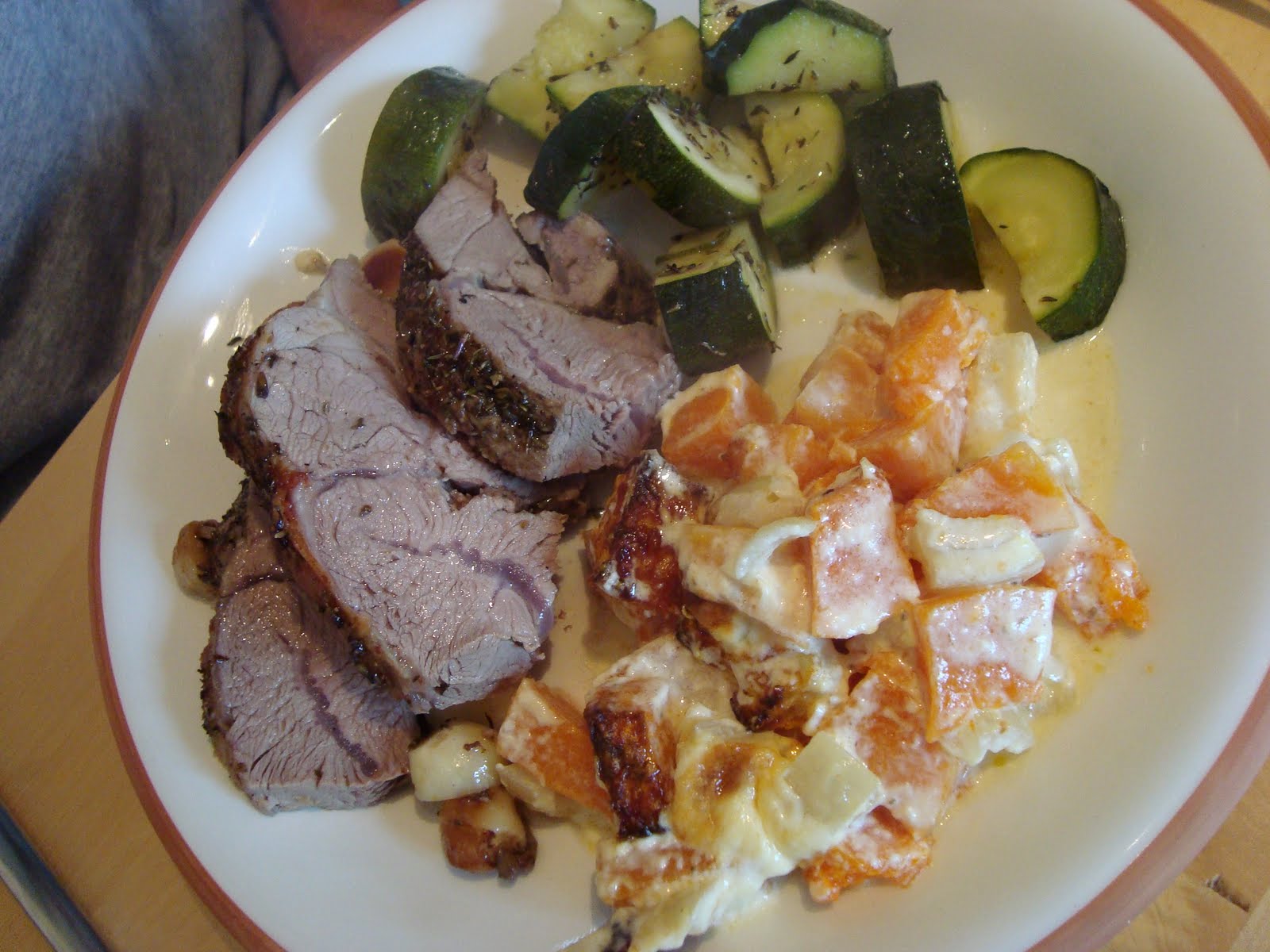
As such, a Sunday dinner of roast lamb, roasted courgettes with thyme, and a pumpkin gratin is definitely comforting.

I love pumpkin. I love buying big slices of it- thick, green and gold ridged skin, bright golden-orange inside. Mm, all the things that can be done with pumpkin! Pumpkin risotto and pumpkin soup are ones that spring to mind immediately- not least because pumpkin with bacon is definitely a happy-making combination.

And it's an easy thing to cook- you peel it (I either use a vegetable peeler or just chop bits off with a sharp knife, depending on the depths of the ridules between sections), chop it, and you're ready to do whatever you want to do with it.

In this case, obviously, gratin.

Now, some of my older French cookbooks say that the problem with pumpkin, and other vegetables such as endive/chicory, when you gratinée them, is the amount of water they ooze out into the surrounding cream, diluting it and making the whole thing taste rather bleah. They therefore recommend a pre-cooking, followed by much squeezing-out of water, followed by the gratin process.

I'll go with that on endive/chicory, but I've never had that problem with pumpkin. I just chop it, chop an onion, chuck them into my dish, stir them around, add black pepper, pour cream over until just below the edge of the dish, and stick it in the oven. In this case, for as long as the lamb took to cook- about 70-80 minutes at 200C.

Result- nice crunchy sweet burnt bits in a few spots on top, and lovely, sweet, creamy pumpkin underneath.

Perfect for an evening when you should have been out all day, but couldn't be without wearing a sou'wester. And I don't own a sou'wester.

Friday, 23 April 2010

Strawberries in April. Dumb, or what?


Why do we buy strawberries in April? Even though we know they won't taste of anything?

Because... well, because the weather tells us to. The glorious, warm, it-can't-be-summer-already weather. The weather that causes us to go out in a sleeveless vest-top, and get sunburned. Twice. In three days.

There is also the fact that Greta seems to like strawberries quite extensively. And, as I'm still watching everything that goes into her mouth (despite days where she appears to be quite prepared to devour the entire planet- as they're usually followed by several where she quite obviously thinks that I'm trying to poison her with all this horrible evil nasty stuff like Petit Suisses- I liked those yesterday, Mama, aren't you keeping up?), I'm quite happy to buy anything that is remotely healthy, and stuff it down her.

It makes up for the saucissons-apéritifs. Really it does.

Strawberries, however, rarely taste of anything much this time of year.

Not without applying various techniques to them- the main one of course being the addition of a certain quantity of brown sugar, and then leaving them to macerate for a while. My other semi-secret addition at the moment is an extremely generous dusting of freshly-ground cinnamon. It seems to do the trick...

Thursday, 22 April 2010

Mayonnaise- not as hard as they said!


Making mayonnaise isn't actually that difficult. As long as you have the right tools, and you're not in a rush.


I haven't made mayonnaise in years- quite literally, as I can tell you that the last time I made it semi-regularly was in 2002, when we were living in New York, and, for the life of me, I couldn't find what we consider "real" mayonnaise.

Hellman's, yes, but that's not real. It's not the right colour, it's not the right texture, and it's not made with the right oil.

As far as I'm concerned, anyway. I didn't grow up with Hellman's, that means that it's just Not Right.

Therefore, rather like the year before, when we were living in the Caribbean and the only bread I could find was steam-baked and tasted sweet, I started to make my own.

With, in this case, a bottle of sunflower oil, tracked down at vast expense. Why it was so expensive, I wouldn't know, but I remember it being something insane like 10$ for a 220ml bottle. Or thereabouts. No doubt that my brain has preferred to wipe the memory from my wallet.

So I made mayonnaise, a few times, and I remember it taking a while, being a bit tricky the first time, but being generally OK. My Larousse Gastronomique told me that everything ought to be room temperature, and I seem to remember that I only read that after making it the first time!

However, having friends staying who were stuck due to Volcano Ejs-something-or-other, I was determined to feed them properly in order to cheer them up. French and Spanish asparagus having finally hit the market, I fed them twice in three days on asparagus for a first course. Once hot, and once cold.

Both times, I made the mayonnaise about an hour or so beforehand. The first time, having forgotten about the room-temperature rule, I had to stick my eggs in warm water for about ten minutes beforehand. It really didn't seem to make much difference.

Mayonnaise for four:
- 3 egg yolks
- olive oil
- sunflower oil
- mustard ("prepared" mustard is, I believe, the technical term)
- salt flakes
- ground pepper

Making mayonnaise easily depends, very much, I think, on being comfortable whilst you work. Therefore, I use a small bowl with a handle, which means that I can hold the bowl without getting cramp in my palm, and also hold the bowl at different heights in order to give my wrist a rest. Also, you really need a whisk with a thick handle. A small whisk, obviously, as you're only whisking three eggs, but you don't want one with a thin handle- it will just give you cramp in your palm and make the whole thing uncomfortable.

Whisk your egg yolks briefly, to mix them and break them up.

Now, all the books say to start with a teensy drop of oil, whisk like mad, and work your way up very slowly from there. I don't hugely agree with this. A drop, yes, whisk, then keep going, but you really don't have to put in the teensiest drop at the start. As long as you whisk hard and fast, you'll be OK.

Take your time. The first five, six times, a small drop, then you can go for a teaspoon at a time. Not that you need to measure it out! Just what looks about right.

The whole thing shouldn't take more than ten minutes. And that includes breaks to rest your shoulder- you don't have to keep going the whole time.

Now, I haven't given measurements for the oils. This is because I have no idea. I taste mine as I go along. Olive oil gives quite a strong flavour, and you may not want this. If you've got to a flavour that's too strong, stick to sunflower oil from then on in. I tend to swap my oils about after 4-5 additions. But my finished product is probably about 2/5 olive, 3/5 sunflower.

At the end, I add mustard, salt, pepper. This dilutes the mayonnaise, and you have to add more oil. I also add the mustard to taste- whatever seems right to me, which seems to end up being about 3 tsp.

That was my basic recipe- however, the last time I made it (I didn't really mean to, but I had four egg yolks from a recipe I was making, so I stopped half-way through and made mayonnaise), I made some changes.

English mayonnaise:
- 4 eggs
- 2 tsp English mustard powder (Colman's!)
- 4 tsp white wine vinegar
- olive oil
- sunflower oil
- salt, pepper

This time, I whisked the eggs, added the mustard powder and white wine vinegar, then added the oils. Salt and pepper at the end.

It then went in a labeled jam jar in the fridge, and Peter has been very happily smearing it on bread and eating it like bread-and-butter ever since! It's funny- the olive oil taste shows up first, and it's only after you've swallowed that the mustard sneaks up and whacks you across the back of the throat. Which, I think, makes it fine for sandwiches, fine for eating on bread, but not quite so fine for eating with asparagus.

Wednesday, 21 April 2010

Cupboard Cake- Dried apricot and flaked almonds


Why are you torturing me with this cake, Mama? Why?


I have mentioned Betty Bossi before.

Betty Bossi is the Swiss Betty Crocker. I understand that the identical first names is coincidence, although it is rather amusing.

Betty Bossi does not produce cake mixes. It primarily produces a little magazine, sent to subscribers ten times a year, with seasonal recipes. Of course, over the years, it has expanded into cookbooks, and into an online shop selling cake tins (d'you see that one just above?), measuring spoons, Useful Household Items (that are pretty useless in some cases), cleaning items, all that sort of stuff. Some of which I own, such as the sunflowers for putting in between your non-stick casseroles/frying pans, so they don't scratch each other.

Absolutely vital for the harmony of your drawers, I assure you.

I probably have about 15 Betty Bossi cookbooks, as I am a good, Swiss-emulating semi-hausfrau.

Really, I am. Honest. Pay no attention to my tattoo, OK? It was a youthful aberration, now safely covered over by the dirndl.

Well, not quite.

To get back to my point, and the cookbooks. Over the years, although I've collected them, I've never really been inspired by any of the recipes enough to actually cook from them. I remember one, the only one I made, being Poulet au Paprika, from a "Betty's Greatest Hits" cookbook, which was given such a write-up that I couldn't not make it.

I ended up making it twice, just to be sure that it really was as disappointing as it seemed on the plate. Basically, it was a lot of melted butter, a couple of tablespoons of paprika, and you basted the chicken with it multiple times during cooking, in order to ensure that the flavours sank into the chicken. Except that they didn't. It looked very pretty, though.

And yet... oddly... the last few months, I've been tearing out recipes to make from my semi-monthly magazine. Instead of flipping through it and dropping it straight into the recycling, which is what I've been doing for years.

The April issue had a section on "cake" recipes. I use inverted commas, as this is "cake" in the French sense, not in the Anglo-Saxon sense- namely a loaf, or a bread. Banana bread would be called a "cake" in French.

This section is made up of one basic recipe, and various recipes for additions to that basic mix- starting with chocolate, moving on to nuts, rhubarb, lemon and strawberry, blueberries, and ending with one including apples and caramels (as in sweets), and another with chocolate truffles.

The basic recipe is as follows:
- 150g butter, softened, in cubes
- 200g sugar
- 1 pinch of salt
- 4 eggs
- 250g flour
- 1 coffee spoon baking powder

Cream the butter, sugar, and salt. Add one egg after the other, mix for about 5 mn, until it lightens in colour. Mix the flour and baking powder, add to the butter mix, stir. Pour into the mold, bake for about 50 mns in a pre-heated oven at 180C. Remove from the oven, leave to cool slightly, remove from mold, allow to cool on a wire rack.

The other recipes just add ingredients to this basic mix, sometimes with an extra egg, occasionally extending the cooking time.

It's a pretty good base, I think.

And thus, when I had some friends call up from Italy with a cry of "Help, the volcano has stranded us, please take us in until we can fly home!", one of my first thoughts for their sustenance (both emotional and gustatory) was to make "cake".

Not having any of the ingredients in the variations, however, other than the chocolate, I made up my own version, using ingredients left over from my marathon baking sessions before Christmas. And using them up, thank goodness!

My version had
- 2 packs (300g?) of dried apricots, chopped into rough cubes
- 1 pack (200g?) of flaked almonds

It was very, very nice.

My friends got here at about 11 p.m. one evening a few days later, and we sat down and ate about half of it. I left the rest of it out (covered) to be snacked on, and it was gone by the next evening.

I then made a version using a left-over apple, chopped, and some dried cranberries, but it just wasn't as good.

No matter- it's a good basic recipe to have! Even if Greta... wasn't too impressed.

Sunday, 18 April 2010

Pork Paprikash (sort of)


I try to do a lot of cooking of the "What's on special offer at the supermarket" variety. As we all do these days.

The other day, ragout de porc being on cheap, that was obviously what we were going to be eating.

Last time I bought such packs, the meat was in reasonably large chunks- this time, each piece came with at least one long thin bone running right through it, and although I could have chopped them through with a cleaver and a call to Peter to come and use some muscle power, I didn't bother.

First I browned the pieces, then took them out of the casserole, and left them to sit whilst I tipped in onions in thick slices, softening them gently and slowly in the fat from the pork. I added a heap of spices: about 2 tbs of mild paprika (I find this has so little taste, I usually only use it for colouring!), 1 tbs of hot paprika, about a tsp and a half of cumin seeds, about 1/2 a tsp of cinnamon, black pepper, a couple of big pinches of marjoram, and a bit of herbed salt.

I let all the spices warm up with the onions, stirring, then added a whole bottle of white wine- a Petite Recolte from Nicolas, Cotes de Ceressou Moelleux from 2004. I really liked this wine back in 2004, so I had some crates of it, and this was the last bottle. I poured myself a glass before tipping the rest into the casserole- then tasted my glass, and poured that in too. It had no depth of flavour left at all- just a surface layer of "hello, this is a grape-based alcohol".

I have very little palate for wine, but I do know when there's nothing there.

I brought the stew up to the simmer, then added a bottle of passata- about 700 ml. Back up to simmer, put the meat back in, and simmered it gently, with the lid on, for three hours.

Very gently removed the meat, which was falling apart, and pulled out most of the big bits of bone. I then reduced the sauce like mad, boiling it fast with the lid off, and it thickened very satisfactorily. I had originally planned to add mushrooms, but once I'd put in the tomato, I changed my mind.

I really must use up those mushrooms.

Put the meat back in, warmed it all up, and served it over egg noodles. Yummy- it did Peter and I two meals, and a third one for him.

This week, there was a special offer of cote de boeuf (one bought for Peter, I will nibble around the edges and probably eat vegetables instead), and liver. I love liver. There are two lobes for each of us in the fridge... probably to be cooked dredged in seasoned flour, then fried quickly, and served in slices either with mushrooms and onions, or just onions, or maybe with egg noodles again.

We have some friends turning up on Monday night, rather unexpectedly, as they were on holiday in Italy and are now, due to the volcano, stuck there and can't get home. So they're coming here until they can get a flight out. So I'm going to have to do some food shopping and planning for the coming week, as I'll be feeding double the usual number! Besides having to plan it more than my usual "open the fridge, then decide what I'm cooking" method.